Loan Types and Loan Comparison Education: A Practical Guide for Responsible Borrowing
Loan Types and Loan Comparison Education are critical for anyone planning to borrow money in 2025. Loans can solve short-term financial challenges or support long-term goals, but poor decisions can create years of financial pressure.
Many people apply for loans without fully understanding repayment structures, interest calculations, or total borrowing cost. They focus on approval speed or low monthly installments while ignoring long-term consequences.
This guide explains Loan Types and Loan Comparison Education in a clear, responsible, and educational way. The purpose is awareness — not promotion.
For general information of trading
https://abpoints.xyz/trading-basics-in-2025-blueprint/

What Is Loan Types and Loan Comparison Education?
Loan Types and Loan Comparison Education refer to understanding different borrowing options and evaluating them carefully before making a financial commitment.
A loan is a legal agreement between a lender and a borrower. The lender provides funds. The borrower agrees to repay the principal amount plus interest within a specified period.
Every loan includes:
- Principal amount
- Interest rate
- Repayment tenure
- Processing charges
- Penalties (if applicable)
Understanding these elements is the foundation of smart borrowing
How Loans Work in Practical Terms
When applying for a loan, lenders assess:
- Income stability
- Credit history
- Existing obligations
- Employment type
- Repayment capacity
Approval is not automatic. It is based on risk evaluation.
For example, a salaried employee with stable income and clean credit history is considered lower risk than someone with irregular income.
Missing payments may result in penalties and negatively affect credit score.
Learning Loan Types and Loan Comparison Education helps borrowers avoid emotional decisions driven by urgency.
For broader personal finance basics, explore:
https://abpoints.xyz/money-management-in-2025/
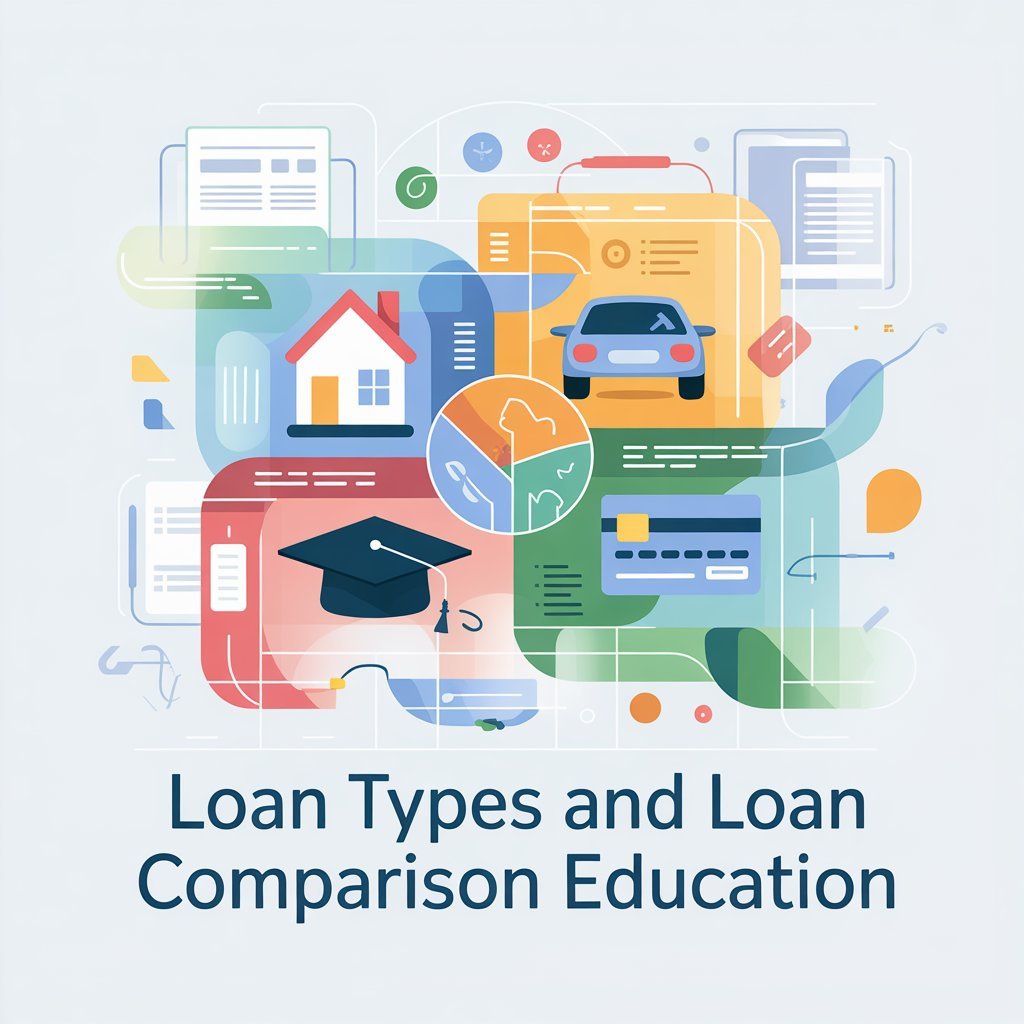
Major Loan Types Explained Clearly
Understanding categories is central to Loan Types and Loan Comparison Education.
Personal Loans
Used for general purposes such as medical expenses, travel, or debt consolidation.
Usually unsecured. Approval depends heavily on credit profile.
Home Loans
Used for purchasing or constructing property.
Typically long-term loans with structured repayment plans.
Education Loans
Designed to fund tuition and academic expenses.
Repayment may begin after course completion.
Business Loans
Used for working capital or expansion.
Approval depends on business financial records and projected stability.
Each loan type serves a specific financial need. Using a loan outside its purpose increases repayment risk.
Secured vs Unsecured Loans
Loan Types and Loan Comparison Education also require understanding collateral.
Secured Loans
Require an asset such as property or deposit as security.
If repayment fails, the lender may recover dues using the asset.
Unsecured Loans
No collateral required.
Approval depends on creditworthiness and income stability.
Secured loans may offer lower interest rates but involve asset risk. Unsecured loans carry higher interest due to increased lender risk.
Choosing between them depends on financial stability and risk tolerance.
How Interest Rates Impact Total Loan Cost
Interest structure directly affects total repayment amount.
Even a small percentage difference can significantly increase total cost over long tenure.
Many borrowers focus only on EMI (monthly payment). However, lower EMI over longer tenure often means higher overall interest paid.
To understand interest calculations clearly, refer to this educational guide (DoFollow):
https://www.investopedia.com/terms/i/interest.asp
Understanding this concept is central to Loan Types and Loan Comparison Education.
Fixed vs Floating Interest Rates
Loan interest can be structured in two main ways.
Fixed Interest Rate
Interest remains constant throughout the loan term.
Provides predictable monthly payments.
Floating Interest Rate
Interest fluctuates based on market conditions.
Monthly payments may increase or decrease.
Borrowers seeking stability often prefer fixed rates. Those comfortable with variability may choose floating rates.
Decision should depend on financial comfort — not short-term market trends.
Eligibility Criteria and Documentation
Loan Types and Loan Comparison Education include knowing eligibility requirements before applying.
Common criteria:
- Stable income
- Acceptable credit score
- Limited existing debt
- Valid identification
Required documents often include:
- Identity proof
- Income proof
- Bank statements
- Address verification
Applying without meeting eligibility standards may lead to rejection and credit score impact.
Understanding criteria protects long-term financial credibility.
How to Compare Loans Properly
Loan comparison is the most important step in responsible borrowing.
Factors to compare:
- Annual Percentage Rate (APR)
- Processing fees
- Prepayment penalties
- Repayment flexibility
- Customer service reliability
Two loans may appear similar but differ significantly in total cost.
For consumer-focused guidance, explore (DoFollow):
https://www.consumerfinance.gov/consumer-tools/
Loan Types and Loan Comparison Education emphasize evaluating total cost, not just monthly installments.
Common Borrowing Mistakes to Avoid
Learning Loan Types and Loan Comparison Education helps prevent costly errors.
Common mistakes include:
- Borrowing without clear purpose
- Ignoring total repayment cost
- Overestimating repayment ability
- Choosing loan based only on speed of approval
- Not reading loan agreement carefully
Responsible borrowing requires careful evaluation.
When Should You Avoid Taking a Loan?
Not every financial situation requires borrowing.
Consider alternatives if:
- Expense is not urgent
- Savings can cover the cost
- Borrowing exceeds comfortable repayment limits
- Loan terms are unclear
Loans should support financial goals — not create long-term stress.
Practical Tips for Smart Borrowing
To apply Loan Types and Loan Comparison Education effectively:
- Calculate your repayment capacity honestly.
- Compare at least three lenders.
- Understand total cost, not just EMI.
- Maintain emergency savings separately.
- Avoid multiple loan applications simultaneously.
Discipline reduces future financial pressure.
For saving and budgeting fundamentals, explore:
https://abpoints.xyz/control-daily-expenses/
The Long-Term Impact of Poor Loan Decisions
Poor loan planning can lead to:
- Increased debt burden
- Reduced credit score
- Financial stress
- Limited future borrowing ability
Responsible borrowing protects long-term stability.
Loan Types and Loan Comparison Education exist to prevent such outcomes.
Final Thoughts on Loan Types and Loan Comparison Education
Loan Types and Loan Comparison Education empower individuals to borrow responsibly.
Loans are not inherently harmful. Lack of understanding creates risk.
By learning:
- Loan categories
- Interest structures
- Eligibility requirements
- Comparison methods
Borrowers can make informed decisions aligned with long-term financial goals.Smart borrowing is built on awareness, discipline, and careful planning.
Click the internal link below for reading about Spot trading :
https://abpoints.xyz/spot-trading-in-2025/
Disclaimer
The content in this article, 9 Powerful Loan Types and Loan Comparison Education Strategies for Smart Borrowing Decisions, is provided for educational and informational purposes only. It is not financial, lending, legal, or tax advice, and should not be interpreted as a recommendation to apply for, use, or endorse any specific loan product or financial service.
Borrowing and loans involve financial risks, which may include but are not limited to:
- Debt and repayment obligations: Failing to repay a loan according to its terms can result in penalties, interest accumulation, and negative impact on your credit score.
- Interest rate risks: Different loan structures and fluctuating interest rates can affect total repayment amounts.
- Eligibility and approval risks: Not all borrowers qualify for loans, and multiple loan applications can affect credit ratings.
- Financial mismanagement risks: Over-borrowing or borrowing without proper planning can create long-term financial stress.
- Regulatory and institutional risks: Loan terms, eligibility criteria, and rules may vary by institution and jurisdiction.
Readers are encouraged to conduct independent research, review loan terms carefully, and consult qualified financial advisors before making borrowing decisions. The author, website, and affiliates do not assume responsibility for financial losses, legal issues, or other consequences resulting from following this content.
By accessing this article, you acknowledge that all borrowing decisions are your sole responsibility, and you agree to use this information at your own discretion and risk.


Useful insights for choosing coverage that actually fits real needs.